Posts

Showing posts with the label cinema

Deadly Cinema and Secret Cinema

Image
At the weekend I picked up in a charity ("thrift") shop a short book by world theatre director and experimenter Peter Brook called The Empty Space , first published in 1968, with a Pelican paperback in 1972. There have been several reprints and it's still a thoughtful discussion of the state of theatre. Where he speculates on 'Theatre' I found myself reflecting on 'Cinema.' It's a curious exercise to displace and compare terminologies and discourses. Sometimes it's quite shocking and sobering as a thought experiment. What did the theatre mean to him in 1968, and what does it mean to us in 2011? How have our ideas about the value(s) and function of cinema evolved alongside, or in opposition to 'theatre' ? If you're curious, his four chapters are titled The Deadly Theatre The Holy Theatre The Rough Theatre The Immediate Theatre I also found myself dreaming about a Secret Cinema . Perhaps a lost chapter of the Brook...
Ten Routes for Community Film Distribution

Image
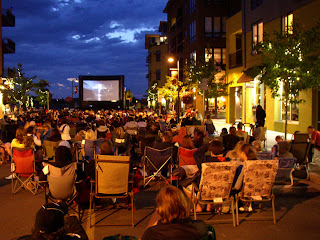
Open Air Cinema 1. How Content and Style determine the Target Group It is alleged that very few community film makers start out with a clear sense of how their finished film will be distributed. This is the vexed question of the target audience. It also brings into play questions about the content of the film – the product – and whether it is fit for purpose in terms of its spectators. That means that the distribution agenda should always already be built into your production and planning process. There’s clearly no point filming disturbing adult scenes that will be unusable for a target group of children. And will people really sit through a two hour community film on any topic, unless they were major participants throughout? Is your film relevant to a wider community, and how can you get it out there? Here are some options to think about: Evaluating Distribution Options 2. Broadcasters: TV, Cable and Satellite (including Free-View Services). Apart fro...

How to 'republish' free material from Wikipedia IS a Corporate Scandal

Image
How profitable, or ethical, is it to republish work that is available for free on wikipedia? I was surprised and rather angry that our free wikipedia article called "Community Film" has now appeared as a "book" edited by Zheng Cirino. But Duc Publishing is just an imprint of VDM Publishing. (See below) Has anyone come across this 'writer' and 'editor' of over 4500 books? Would you spend £25 on what you can have for free? Take a look on Amazon . And the cover bears the curious imprint  'Books for Africa'. OK. So this is about social mission and redistribution, right? I would be curious to see how they reference and attribute my work based on the Wikipedia Edit / page history. But I don't think I need to waste £25 reading my own work, which is already available for free! (Even the Product Description simply copies my words from the opening of the Wikipedia article on COMMUNITY FILM) Here is what one commentator (erich66...

A Blog Tool Kit for Digital Community Media

Image
I can't believe that's over two years of blogs.  Here are some of the most popular posts from the 80+ published :  18 Advantages of visual auto-ethnography for resea... Social Media, Revolution and Historical Consciousn... Reflections on social media and 'anarchy' in Birmi... Civil Society Groups and Volunteer Film Projects Our 3-minute film guide Film Editing for Beginners – Understanding the Pro... Radical Origins of the 'Big Society' ? 30 Tips to help you make an Award Winning Film on ... What is Community Film ? 30 Ways to Put the Community Into Film ... India's answer to Hollywood and No-Budget film pro... A Recipe for Auteur Film Directors (14-point toolk... Participatory Video - the role of the Trainer and ... Beyond CinemaScope and Technicolor: the World of A... Towards an Imperfect Cinema Worldwide Community Film Screenings Postcolonial and Transnational Cinema...

Participatory Video - the role of the Trainer and the Researcher

Image
Namita Singh is currently pursuing a PhD on Participatory Video in UK, at the Open University. She is a researcher and consultant focused on participatory media. We welcome her guest contribution to this site and thank her for her insights into and for sharing her reflections on Participatory Video. "Namita Singh, the Trainer Vs. Namita Singh, the Researcher :  Things I taught and things I learnt!"  This one week taught me so much about doing Participatory Video, as a researcher. Going in, I never thought, it will be as tough – negotiating the thin line between Namita Singh, the trainer, and Namita Singh, the researcher. The former being my role throughout my working life prior to my PhD, the latter, I am supposed to strictly adhere to, so as not to lose sight and data, while I am at it. Every bit is important. Every bit might have some key, some vital insight – a hidden answer to my research questions – some serious business, this! I had wanted to us...

Cult Auteur Film Directors: A 14-point toolkit for your career

Image
1. The auteur typically employs multiple perspectives on the same scene. This approach will enable the auteur to transform a short story into a film of epic proportions. The auteur characteristically demonstrates disregard for linear plotting . For the auteur Repetition is at the core of Deconstruction. 2. The auteur prefers grainy features to suggest the archaic; s/he prefers black and white to colour. The auteur composes lyrical essays on the lure of the silent film era; employs super 8 film, and cuts up video tapes using a manual process. At the other extreme, the auteur films his homage to Battleship Potemkin (1925) using only mobile cell-phones and skateboards. 3. The self-presentation of the auteur in interview situations is a form of self-preservation. There are two starting positions that should be adhered to without irony: (a) sentences that deploy stream-of-consciousness; multiple subclauses (think Henry James's Golden Bowl ); polysyllabic terms - especially...

Nonprofit Viral Video Success - A Guide

Image
There's quite a lot that nonprofits, activists, community workers and creative people can learn from corporate media and advertising in order to make a well-meaning video "go viral."  Much of the advice on viral video is common sense. Follow these simple steps in order to promote your viral video: include a link or preview of your viral video in all your emails; find out where your supporters and communities of interest are; learn about the social and ethical preferences of your viewers; take part in relevant social media conversations and mention your viral video; respond to popular and relevant videos with similar themes; choose an eye-catching thumbnail - remember that this is what will show up in search results; link to a popular event - and release your video to 'correspond' with news items; use keywords from popular events to help people to 'stumble upon' your viral video; post a personalized thought-provoking message ...

20 Threats to Social Film and Participatory Video

Image
The advent of affordable technology (cameras and software) together with popular platforms designed to share and to show work (such as YouTube) appeared to promise a golden age for social films and participatory video-making. What went wrong? What happened to all that social energy? Is there hope for the future? All the really interesting films are still out there, but they can take a lot of finding; or perhaps they are just swamped by more commercial forms of "entertainment." If you want to find out about social protests such as the Occupy movements across the world there are thousands of films to watch. But should we be anxious that the mainstream appears to be so frivolous and trivial? Is there an argument that being serious, social and participatory is just not radical; that it's out of fashion? For the sake of debate this blog explores one side of the topic: the failure of social film and participatory video to catch on. In the non-commerci...

Collaboration, Art, and the Discourses of Participatory Film

Image
Collaboration, Art, and the Discourses of Participatory Film The discussion of collaborative approaches to making films has moved into prime position during the last year. It’s a very healthy situation for community-led film makers and bodes well for the future role of digital arts and participatory democracy. At last we have some worthy examples of theory, technology and practice working together in a creative fashion. The BBC has recently featured a news item on an innovative collaborative film project to be called My Streets. The project has major establishment backers, and is perhaps another example of popular participation filtered through selective curators. The patchwork is a familiar model for the community portrait. Recurring themes will perhaps oscillate with chance collisions in the manner of collage. We can celebrate the flickering poetry of surprise in the global 24 hour project Life in a Day which saw thousands of collaborators generate a feature length film cura...

Postcolonial and Transnational Cinema

Image
Here are some recently published books on postcolonial film, third cinema and transnational cinema. If you have any other recommended books feel free to comment and add any suggestions below. Barlet, Olivier. African Cinema: Decolonizing the Gaze. Translated by Chris Turner. New York : Zed, 2000 Bernstein, Matthew, and Gaylyn Studlar, eds. Visions of the East: Orientalism in Film New Brunswick , NJ : Rutgers University Press, 1997. Brunt, Rosalind (Editor), Cere, Rinella (Editor) Postcolonial Media Culture in Britain Palgrave Macmillan , 2010. Ďurovičov á , Natasa ; Kathleen E Newman. World cinemas, transnational perspectives  Routledge 2009   Ekotto, Frieda (Editor), Koh, Adeline (Editor)   Rethinking Third Cinema: The Role of Anti-colonial Media and Aesthetics in Postmodernity (Kultur Forschung Und Wissensch) Lit Verlag, 2010. Ezra, Elizabeth (Editor), Rowden, Terry (Editor) Transnational Cinema, the Film Reader (In Focus: Ro...

What is Community Film ?

Image
"Community film" is a variety of practices and approaches that interrogate the dominant use of "film" and "cinema" in association with a global, big budget "industry".   "Community film" draws on the democratic and participatory potential of new technology which has decreased the cost of entry for new film makers, new distributors, and wider, more interactive audiences. Taking the argument further, the traditional power triangle of film maker-distributor-spectator can also be challenged and opened up. As a global movement "community film" preserves the integrity and identity of the local community (and importantly, dialogues between local groups) against the homogenization of the the dominant transnational industries that seek to erase distinctive voices in order to create their commodities and oppressive brands.  "Community film" challenges the notion of "film" as a 90 minute, big bud...